Most summer houses and garden rooms do not need planning permission, and many do not need building regulations approval either. But the limits are precise. Height, distance from the boundary, how you use the building and where your house is all decide which side of the line you fall on.
This guide is for homeowners in Hemel Hempstead, Berkhamsted, Tring and the rest of Dacorum, where Dacorum Borough Council is the planning authority. The national rules are the same in neighbouring St Albans, Watford and Three Rivers, but each council handles its own applications and certificates. It is general guidance, and we check the position for your address on the first site visit.
What counts as permitted development
Garden buildings are covered by permitted development rights for houses, known as Class E. They let you put up an outbuilding without applying for planning permission, as long as you stay inside national limits. These rights apply to houses only. If you live in a flat or maisonette, you need to apply.
The main conditions are:
- The building must be for a purpose incidental to enjoying the house, such as storage, a hobby room or a summer house.
- It must be single storey.
- It cannot sit on land forward of the principal elevation, which is usually the front wall of the house.
- Outbuildings and extensions together must not cover more than half the land around the original house.
- No verandas, balconies or raised platforms. A platform or deck must not be more than 0.3 metres high.
The original house means the house as it was first built, or as it stood on 1 July 1948 if it is older. Sheds and garages already in the garden count towards the half-coverage limit, even if they came with the house.
Height limits and the 2 metre rule
Height is measured from the highest ground level next to the building. The limits are:
- Eaves: no higher than 2.5 metres anywhere.
- Overall: up to 4 metres with a dual-pitched roof, or 3 metres with any other roof, such as a flat or mono-pitch roof.
- Within 2 metres of a boundary: if any part of the building is within 2 metres of the boundary, the whole building must be no more than 2.5 metres high.
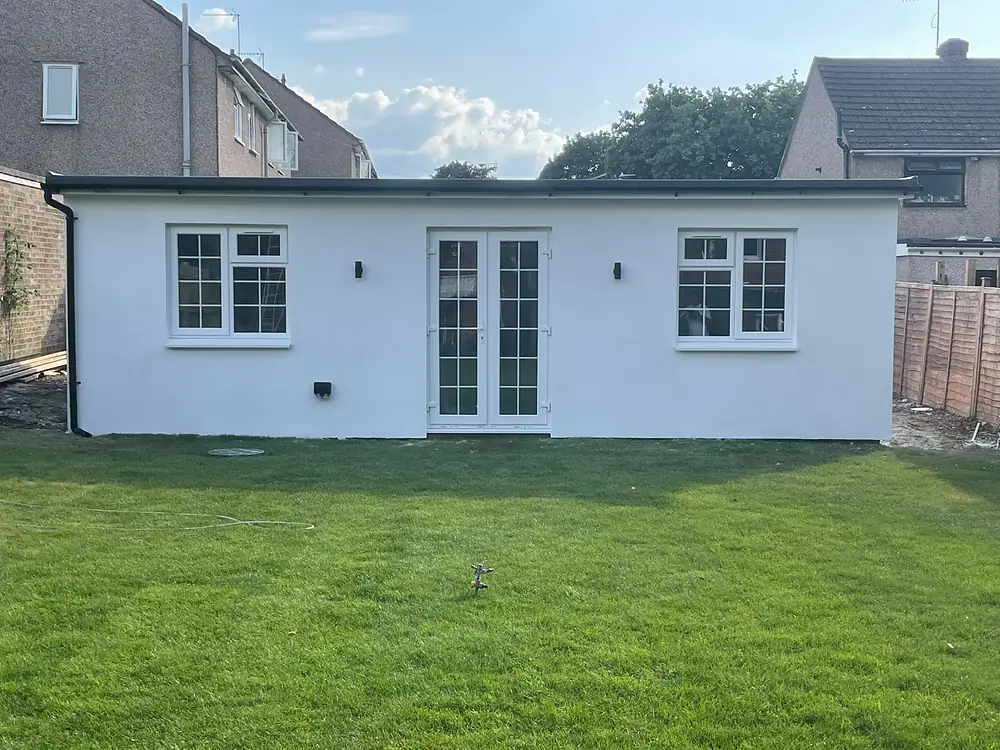
The 2 metre rule catches a lot of people out. Most gardens are not wide enough to keep a garden room 2 metres from every fence, so in practice many garden rooms are built to 2.5 metres with a flat or shallow roof. Decking laid around the building does not count as ground level, so plan the base and the roof together.
Conservation areas, the Chilterns and listed buildings
The rules are tighter on protected land. Dacorum has a number of conservation areas, covering parts of Hemel Hempstead, Berkhamsted, Tring, Kings Langley and many of the villages. Large parts of rural Dacorum, including Aldbury and the countryside south of Tring, also lie within the Chilterns National Landscape, which was known as an Area of Outstanding Natural Beauty until November 2023.
- Conservation areas and the Chilterns National Landscape: an outbuilding between the side wall of the house and the boundary needs planning permission.
- Chilterns National Landscape only: buildings more than 20 metres from any wall of the house are limited to 10 square metres in total.
- Listed buildings: any outbuilding within the grounds of a listed building needs planning permission.
- Article 4 directions: the council has removed some rights for particular properties, including some in Berkhamsted and Tring.
For more on building in these areas, see our guide to planning permission and permitted development in Dacorum, which also covers newer estates where rights were removed by planning conditions.
Garden office, gym or bedroom?
How you use the building matters as much as its size. The government's technical guidance says permitted development does not cover primary living accommodation, such as a bedroom, bathroom or kitchen, or separate self-contained accommodation. So a garden room that someone sleeps or lives in is outside permitted development, and you need planning permission.
A garden office is a different case. Working from home does not need planning permission if the house stays mainly a private home. The Planning Portal suggests you will probably need permission if your business means:
- a marked rise in traffic or people calling
- activities unusual in a residential area
- noise, smells or disturbance to neighbours at unreasonable hours
A home office or gym used by the household normally sits comfortably within these tests. A space for clients to visit every day may not.
When building regulations apply
Planning and building regulations are separate. A garden building can be permitted development and still need building regulations approval, or the other way round. Small detached buildings are exempt from most of the building regulations:
- Up to 15 square metres of floor area: exempt, as long as there is no sleeping accommodation.
- 15 to 30 square metres: exempt if there is no sleeping accommodation and the building is either at least 1 metre from any boundary, or built mainly from non-combustible materials.
Above 30 square metres, or with any sleeping accommodation, expect to need building regulations approval.
Electrics and water
The exemption does not cover the electrics. If a garden room takes its power from the house, Part P of the building regulations still applies. A new circuit, which most garden rooms need, is notifiable work. The simplest route is an electrician registered with a competent person scheme, who certifies the work and notifies building control for you. Water supplied from the house is also still covered by some of the regulations, so a sink or toilet needs thought early on.
Getting a lawful development certificate
If your garden room fits within permitted development, you do not have to apply for anything. A lawful development certificate is optional. But it gives you written confirmation from the council that the building does not need planning permission.
It is worth having if the building is close to the limits, if you plan to use it as an office, or if you expect to sell. A buyer's solicitor may ask how the building was approved, and a certificate answers that in one document. In Dacorum you apply to Dacorum Borough Council. Check the Planning Portal for the current fee.
How we can help
We design and build summer houses and garden rooms across Hemel Hempstead, Berkhamsted and the rest of Dacorum. On the first visit we measure the garden, check whether your house is in a conservation area or the Chilterns National Landscape, and work out whether the building can go ahead under permitted development. We arrange drawings, a certificate or an application if one is needed, and a registered electrician for the power. See our landscaping and summer houses page for more.
Common questions
Can I put a summer house next to my fence without planning permission?
Yes, if the whole building is no more than 2.5 metres high and it meets the other permitted development limits. If you are in a conservation area or the Chilterns National Landscape, it also cannot sit between the side wall of your house and the boundary.
Can I use my garden room as a spare bedroom?
Not under permitted development. Bedrooms and other primary living accommodation are outside it, so you would need planning permission. Sleeping accommodation also brings the building under building regulations, whatever its size.
Do I need building regulations for a garden office?
Usually not if it is up to 15 square metres, or up to 30 square metres and at least 1 metre from the boundary, with no sleeping accommodation. The electrics are still covered, so a new circuit from the house must be done by a registered electrician or signed off by building control.
Is the planning process the same in St Albans or Watford?
The national permitted development rules are the same. Each council runs its own applications and lawful development certificates, and each has its own conservation areas and Article 4 directions to check.
General guidance for homeowners in England, written in November 2026. Every house is different, so we go through the details for your property on the free site visit.